|
You might be surprised by some of the information about the air you breathe inside
your home. Here are some clean air facts you may not know.
|
 |
|
Select one of the headings below to learn more: |
|
|
|
 |
 |
- The EPA ranks indoor air pollution among the top five environmental risks to public
health.
- EPA studies indicate that indoor levels of many pollutants may be 25 times, and
occasionally more than 100 times, higher than outdoor levels. In general, indoor
air is four to five times more polluted than outdoor air.
- More than 15 million Americans are estimated to have asthma, including one-in-13
school-age children.
- In the last 30 years, the number of people with asthma has gone up by almost 60%.
- 87% of American homeowners are not aware that pollution may be worse inside their
homes than outdoors.
- The World Health Organization estimates that approximately 30% of newly constructed
and remodeled facilities have indoor air quality problems.
- Because they breathe faster than adults, children inhale 50% more air per pound
of body weight than adults and are especially sensitive to air quality problems.
- Over 28 million Americans suffer from hay fever and other allergies.
- According to a study by the Commonwealth of Massachusetts, indoor air contaminants
are responsible for half of all illnesses.
|
 |
|
 |
 |
 |
- Tobacco smoke actually contains over 4,000 compounds, many of which are strong irritants.
- Many ordinary activities such as cooking, cleaning and redecorating can spread indoor
pollutants.
- Most homes generate about 40 pounds of dust per year for every 1,500 square feet
of space.
- About 40,000 dust mites, a common cause of household allergies, can be found in
only one ounce of dust.
- Even a spotless home can allow indoor pollutants to flourish.
Bathrooms, damp basements, and even carpets and furniture are often the prime cause.
- Flowers are a source of pollen, but trees are the main culprits for allergy sufferers.
Many trees, such as birch, alder and pine trees, rely on the wind instead of insects
to distribute their pollen.
- Exposure to indoor air pollutants has increased due to a variety of factors, including
the increased use of synthetic building materials and furnishings, chemically formulated
personal care products, and household cleaners.
- Most homes built after 1979 have tighter insulation wraps that trap smoke, odors
and other irritants indoors.
- It is suggested we drink approximately two quarts of clean water each day. By comparison,
we inhale approximately 15,000 quarts of air each day.
|
 |
|
 |
 |
 |
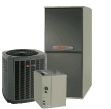
- New TRANE CleanEffects™ is the industry's most effective whole house air filtration
system, capable of removing up to 99.98% of particles and allergens from the filtered
air.
- Keep pets away from home furnishings like beds and couches that can collect their
dander.
- Wash bed linens regularly to inhibit dust mites.
- A relative humidity of 30-50% is recommended for optimal home comfort and controlling
growth of biological irritants like mildew.
- Keep the air at below 50% relative humidity to kill dust mites, one of the most
common household allergens.
|
 |
|
 |
 |
 |
- The EPA ranks indoor air pollution among the top five environmental risks to public
health.
- EPA studies indicate that indoor levels of many pollutants may be 25 times, and
occasionally more than 100 times, higher than outdoor levels. In general, indoor
air is four to five times more polluted than outdoor air.
- More than 15 million Americans are estimated to have asthma, including one-in-13
school-age children
- In the last 30 years, the number of people with asthma has gone up by almost 60%.
- 87% of American homeowners are not aware that pollution may be worse inside their
homes than outdoors.
- The World Health Organization estimates that approximately 30% of newly constructed
and remodeled facilities have indoor air quality problems.
- Because they breathe faster than adults, children inhale 50% more air per pound
of body weight than adults and are especially sensitive to air quality problems.
- Over 28 million Americans suffer from hay fever and other allergies.
- According to a study by the Commonwealth of Massachusetts, indoor air contaminants
are responsible for half of all illnesses.
- Tobacco smoke actually contains over 4,000 compounds, many of which are strong irritants.
- Many ordinary activities such as cooking, cleaning and redecorating can spread indoor
pollutants.
- Most homes generate about 40 pounds of dust per year for every 1.500 square
feet of space.
- About 40,000 dust mites, a common cause of household allergies, can be found in
only one ounce of dust.
- Even a spotless home can allow indoor pollutants to flourish. Bathrooms, damp basements,
and even carpets and furniture are often the prime causes.
|
 |
|
 |
|
|
 |
|
|
|
Find Your Ideal System
|
Use the Trane System Customizer to choose a system based on your unique comfort
requirements
Learn more
|
|
|
|
|