

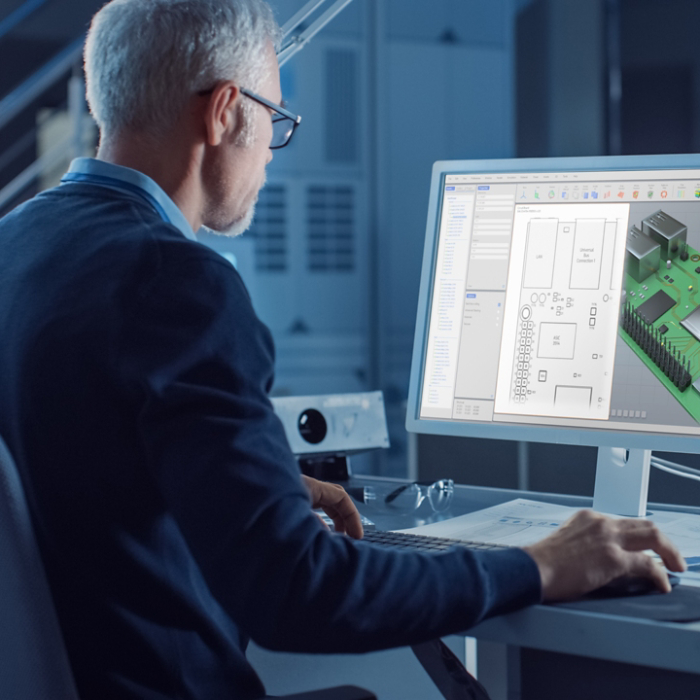
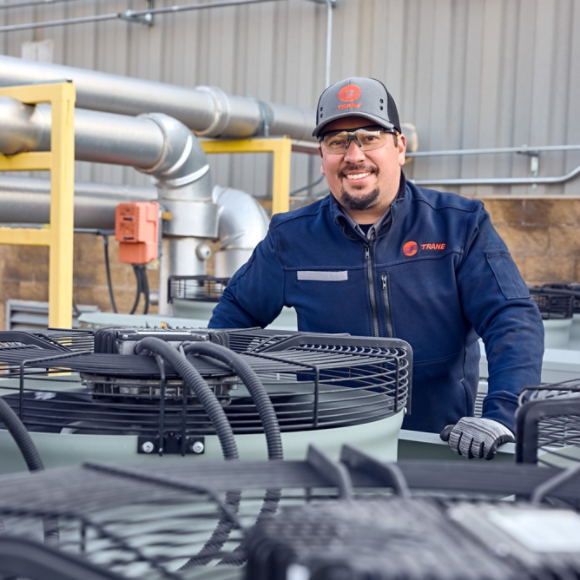

Trane provides tailored data center cooling solutions, ensuring optimal performance, energy efficiency, and reliability. Our offerings include advanced cooling technologies like precision cooling, liquid cooling, and free cooling to reduce energy consumption. We offer modular cooling solutions for scalable capacity and data center HVAC systems that optimize airflow and heat dissipation with features like hot and cold aisle containment. Our energy-efficient HVAC units have advanced controls for real-time adjustments. Trane also provides energy management services with DCIM tools for real-time insights into energy use, temperature, and airflow. We integrate renewable energy sources and offer energy-efficient hardware aligned with sustainability initiatives. Our experts collaborate with clients to develop customized solutions from design to support, helping data centers achieve energy savings, enhanced performance, and reliable operations.
Overview
How can Trane help unlock the potential in your thermal management strategy?
Trane’s data center solutions support hyperscale and colocation data centers by ensuring uptime, reducing operating costs, and optimizing capital investments across all scales.
For colocation facilities, flexible designs and smart controls provide efficient, reliable operations and future ready expansion. For hyperscale data centers, we deliver scalable, automated systems to meet high-density computing needs while maximizing energy efficiency and sustainability. Our streamlined cooling designs and smart controls protect CapEx and reduce OpEx to help ensure long-term value in the fast-evolving data center sector.
Data center performance rules have changed; the future is now.
Our Approach
How does Trane deliver collaborative data center solutions?
Our thermal management experts co-create innovative data center solutions with your team, improving uptime, efficiency and future-ready growth for hyperscale and colocation facilities.
From new innovations to meet your design, performance improvements and retrofits at every stage, our trusted specialists help you move faster and scale smarter.
-
Collaborative solution design day is where clarity begins. Regardless of your data center type or scale, we bring your team and our experts together to define your goals, analyze solution and operational needs, and establish the parameters that shape everything ahead. It’s the first step toward a more efficient data center thermal management strategy.
Reference Designs
How do Trane’s data center reference designs help accelerate scalable, AI-ready infrastructure?
Our engineer-ready reference designs include detailed system layouts, temperature and flow data, and best practices for integrating air- and liquid-cooling, optimizing redundancy and maximizing free cooling. Use them as a proven blueprint to accelerate data center design, reduce energy and water use, and balance performance with sustainability.
Products & Solutions
How do Trane chillers, CDUs, and controls act as an integrated data center cooling system?
Our data center cooling solutions are built to meet the toughest demands of data center operations, engineered to deliver peak performance today and scale with your growth tomorrow.
-
Perfect for modern data centers and industrial applications, our technology ensures optimal thermal management, reduces energy consumption, and enhances performance.
-
Find out how Trane data center chillers and chiller systems are purposefully engineered to meet the AI workload demands of hyperscale and colocation facilities.
-
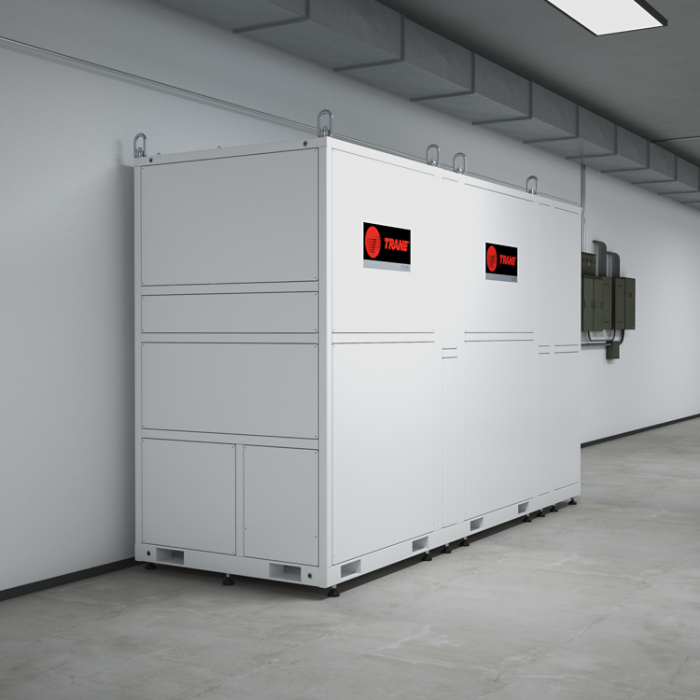
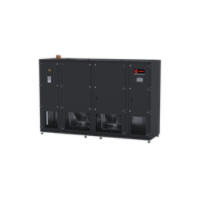
Trane's data center air handlers are engineered for high-capacity cooling and energy efficiency. Optimize your hyperscale or colocation facility’s performance with our expert data center HVAC solutions.
Efficiency
How can Trane's custom thermal management solutions enhance data center energy efficiency?
As a global climate innovator, Trane is committed to helping you achieve your data center sustainability goals while maintaining operational efficiency and mitigating concerns including noise reduction, water usage, energy consumption, and regulatory compliance.
-
Trane offers solutions to help mitigate community relations concerns due to perceived data center environmental impact:
- Noise Reduction: Implementing quieter cooling systems to minimize data center noise pollution or sound level concerns.
- Energy Efficiency: Utilizing energy-efficient technologies to reduce the carbon footprint.
- Community Engagement: Partnering with local communities to promote sustainability initiatives, transparency and identify energy repurposing opportunities.
Insights
Data Center Case Studies, Whitepapers & Insights
-
WUE (Water Usage Effectiveness)
Learn what water usage effectiveness (WUE) in data centers means and discover why it is an important consideration in a facility's HVAC design. -
Learn what free cooling is and how it can help your organization save money and improve its sustainability.
-
Computer Room Air Handler (CRAH)
Learn what a computer room air handler (CRAH) is, how it works, and why a CRAH unit can be a smart component of data center HVAC systems. -
Rethinking Water Usage in Data Centers
Water consumption is a critical design factor for larger data center designs seeking a balance between power and water usage.
-
Optimizing Cooling Power for AI Workloads: A Reference Design Approach
A look at holistic cooling strategies and reference designs that cut peak power, boost efficiency, and optimize AI-ready data center performance. -
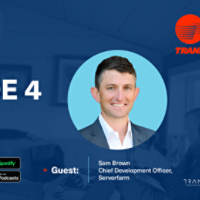
S2E4: Data Centers: Hot Servers, Cool Solutions
Today, Sam Brown, Chief Development Officer at Serverfarm, joins hosts Charlie Jelen and Dan Gentry for a deep dive into the world of data centers.
Events
Data Center Trade Shows, Webinars & More
FAQs
Your top data center questions, answered.
Reducing energy consumption and improving data center energy efficiency can be achieved through several strategies. Optimize cooling systems with advanced techniques such as liquid cooling or immersion cooling and regular maintenance. Improve server utilization by consolidating workloads, using virtualization, and implementing dynamic power management. Choose facility level systems that utilize free cooling when ambient conditions allow. Upgrade to energy-efficient hardware and opt for SSDs and high Energy Star ratings. Use energy management software to monitor and manage usage and enhance power distribution with efficient PDUs and UPS. Adopt renewable energy sources, purchase renewable energy credits, and partner with green energy providers. Conduct regular audits to identify inefficiencies and continuously monitor energy usage.
A sustainable or green data center minimizes environmental impact and maximizes energy efficiency. These centers use energy-efficient hardware, advanced cooling techniques, and optimized power management, often measured by Power Usage Effectiveness (PUE). They prioritize renewable energy sources like solar, wind, or hydroelectric power and may purchase renewable energy credits (RECs). Efficient cooling systems and resource conservation practices, such as water-efficient cooling and recycling electronic waste, are key. Green data centers aim to reduce their carbon footprint and often seek certifications like LEED or ENERGY STAR. Continuous monitoring and optimization through data center infrastructure management (DCIM) tools help maintain efficiency.
Meeting data center sustainability goals amid rising energy demands requires a multifaceted approach. Optimize energy usage with advanced cooling techniques like liquid cooling and free cooling, and hot/cold aisle containment. Invest in energy-efficient hardware with high Energy Star ratings. Use virtualization to maximize server utilization and reduce physical servers. Integrate renewable energy sources like solar, wind, or hydroelectric power, and consider on-site systems or renewable energy credits (RECs). Implement energy management software and DCIM tools for real-time monitoring. Adopt sustainable practices such as recycling electronic waste, using eco-friendly materials, and conserving water. Conduct regular energy audits and benchmark against industry standards. Collaborate with technology partners and participate in industry initiatives. Educate employees and stakeholders on sustainability. These strategies will help your data center meet sustainability goals and manage rising energy demands.
Maximizing data center uptime is crucial for continuous operations. Implement redundancy measures like N+1, N+2, or 2N for power, cooling, and network systems. Invest in high-quality UPS and backup generators and regularly maintain and test them. Use DCIM software for real-time monitoring and proactive maintenance. Ensure robust physical and cybersecurity with multi-layered protocols and continuous monitoring. Develop and update a disaster recovery and business continuity plan, including data backup and system restoration. Train staff and conduct regular drills. Optimize cooling with hot and cold aisle containment and liquid cooling. Stay updated on industry best practices and technological advancements. These strategies will help to ensure data center uptime and reliable operations.
Lowering data center cooling costs involves both capital expenditures (CapEx) and operational expenditures (OpEx). For CapEx, invest in energy-efficient cooling systems like liquid cooling, advanced data center HVAC systems, and free cooling techniques. Modular data centers, hot aisle/cold aisle containment, raised floor systems, and energy-efficient building designs also help. On the OpEx side, regular maintenance, optimized temperature settings, energy management systems, virtualization, and advanced monitoring tools improve efficiency. Renewable energy sources can offset costs. Combining strategies like choosing cooler climates, using energy-efficient IT equipment, upgrading cooling systems, and training staff on best practices ensures optimal operation. These approaches can significantly reduce cooling costs while maintaining performance and reliability.
You cannot future-proof your data center, but you can prepare by designing a scalable infrastructure with modular components for easy upgrades. Invest in energy-efficient, high-performance hardware and advanced cooling solutions like liquid cooling or free cooling. Use virtualization and cloud technologies for better resource utilization and scalability. Implement software-defined data center (SDDC) principles for automated resource management. Ensure robust cybersecurity with multi-layered protocols and continuous monitoring. Plan for disaster recovery and business continuity. Regularly update infrastructure, stay informed on industry trends, and collaborate with technology partners. Adopt sustainable practices, such as using renewable energy. These steps will help to keep your data center adaptable, efficient, and secure.
Connect with an expert.
Still not sure which solution is right for you? Connect with a Trane expert.
Prefer to chat with someone at your local Trane office?